The full value of Machine Learning (ML) and Artificial Intelligence (AI) only emerges when the entire lifecycle of an application is taken into account. Yet many companies struggle to establish a sustainable and scalable operating model early enough in the development process. Helbling’s lifecycle model provides guidance for designing processes more efficiently with ML and AI over the long term and for launching new products on the market in a way that is fit for the future.
The potential of Machine Learning (ML) and the Artificial Intelligence (AI) based on it is undisputed. And yet, over the long term, ML applications in companies often deliver less value than they could. A practical example illustrates this: A manufacturing company launches two AI projects for production — one for automated optical quality inspection and another to support machine operation. Prototypes are developed and deployed on a single production line. Their performance is impressive — a complete success! Nevertheless, both applications remain isolated solutions. They are not transferred to additional lines or use cases as the carefully coordinated day-to-day operations leaves no spare resources for further scaling. Over time, errors accumulate in the applications; they require repeated and laborious maintenance until the effort becomes too great and their use is discontinued. The initial success becomes little more than a memory without lasting substance.
What went wrong? The development of the applications was successful, but too little attention was paid to their operation. Like other software applications, ML-based systems have a lifecycle that, first, does not end following the initial deployment, and second, includes elements that do not apply to conventional software. Sustainable and scalable value from ML and AI depends on a holistic view and actively shaping the entire lifecycle.
Helbling’s ML Lifecycle Model
In recent years, Helbling’s experts have encountered many situations across different companies that are reminiscent of the example outlined above. The problem arises both in internal business processes and in AI-enabled products, whether in medical technology, building automation, or embodied AI. To address this challenge, Helbling developed its own Machine Learning Lifecycle Model, based on project experience across a wide range of fields. The model incorporates interdisciplinary expertise from software engineering, automation, and robotics specialists.
The Lifecycle Model comprises six phases - from the initial use-case definition to monitoring and maintenance during operation - and recommends activities in five areas.
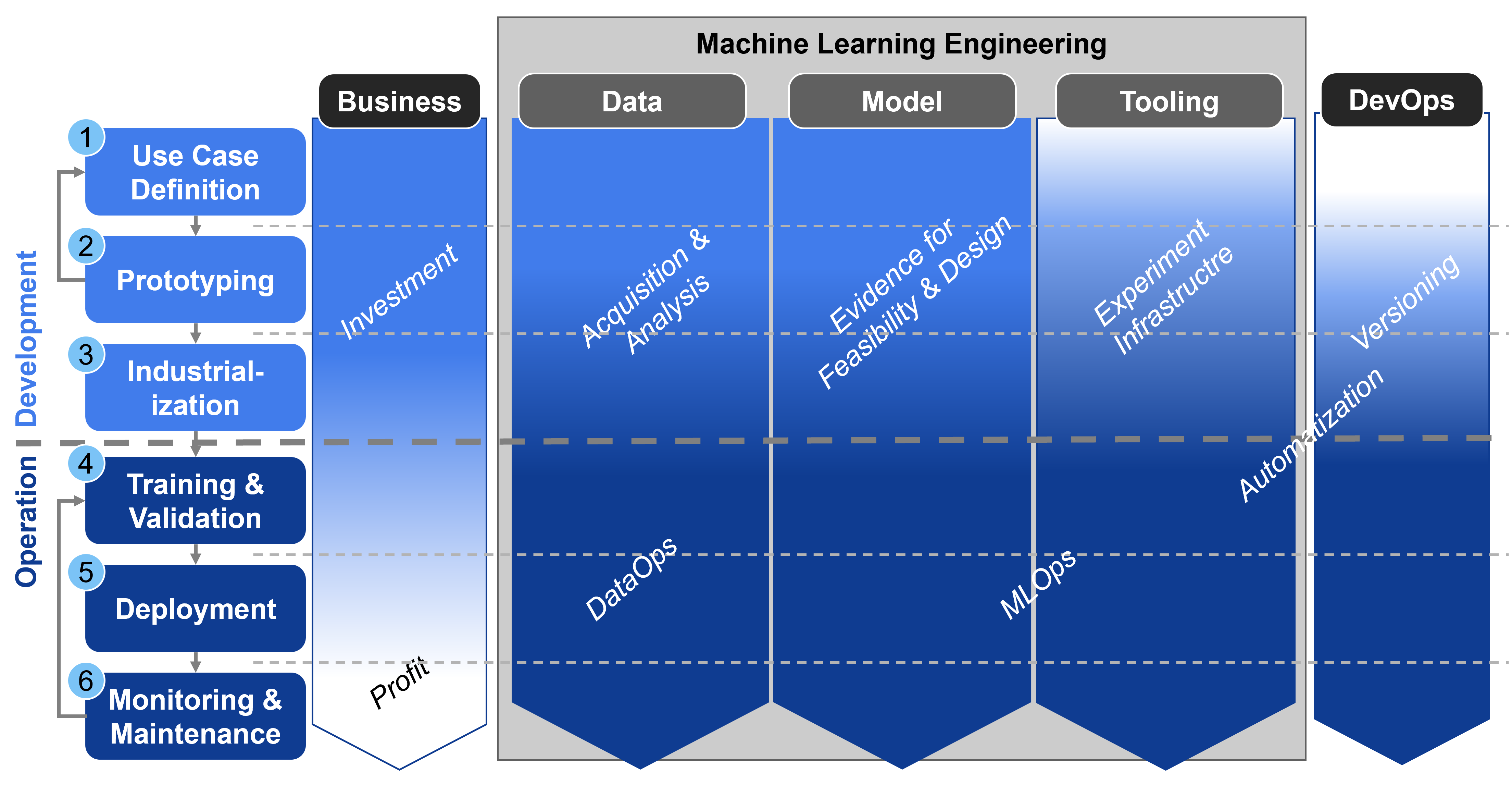
The ML Lifecycle Model was designed as a guide for planning ML projects. Its purpose is to ensure that operational aspects beyond the development phase are considered early and continuously. An ML project does not encompass all six phases from the outset; it typically begins with the two initial phases of use-case definition and prototyping. These phases are more exploratory in nature and require agility. The Lifecycle Model helps to sharpen focus on what will later become important: First, the infrastructure for ML experiments created through Tooling activities will form the basis for later automation of data preparation and model training. Second, consistent versioning of code, data, models, and hardware enables reproducibility and traceability at a later stage. Finally, industrialization also deserves appropriate attention in ML projects; as in any development discipline, the first prototype should not be deployed directly into the field.
The following successful project illustrates the application of the Lifecycle Model, with references to the relevant phases throughout.
Example: Machine Learning in Production
A) From Use-Case Definition and Prototyping to Industrialization
The project began with a complex manufacturing process and the idea of predicting product quality during production rather than measuring it only at the end of the process (predictive quality). This use case was outlined together with the required data and potential ML models (1). The second phase, prototyping (2), focused primarily on establishing evidence as to whether and how the use case could be implemented. To this end, requirements were refined, data was collected and analyzed, and experiments with ML models were conducted. This required custom software tools, which were developed alongside the models and continuously refined. Building these tools provided valuable insights for the later automation of data preparation and model training.
The original use case quickly proved unfeasible - the available data did not contain enough information for absolute quality prediction. However, the evidence gathered showed that changes in quality could be predicted. Based on this insight, a new use case was defined and its value assessed (1). A prototype for this revised use case was developed rapidly using the existing data and tools (2).
During the industrialization phase (3), the laboratory prototype evolved into a robust application. The development team finalized the system architecture and expanded the training dataset. Existing tools were extended to automate training and data preparation. At this stage, the focus shifted from development to operation - not through a sharp transition, but gradually.
B) Continuous Training, Validation, and Monitoring for and within the Application
Alongside model training, validation was also automated (4). The first step was to formalize evaluation in terms of datasets, metrics, and expectations. Data from the most recent three months served as the test set, while all earlier data was used for training. This ensured - and continues to ensure - that model validation remains as close as possible to current operating conditions and that predictions from different models can be compared on a consistent basis.
The trained model was deployed as a dedicated application and integrated into the software of the production line (5). Moreover, automation allowed future model updates to be rolled out efficiently and with minimal effort.
The ML application is now in operation. During runtime, predictions are automatically compared with measured product quality, while input data is checked for consistency (6). In addition, the model is regularly retrained and revalidated (4). As a result, the reliability of the model has improved over time while its validation is always up to date.
In addition to activities focused on data and Machine Learning, typical DevOps tasks increasingly gained in importance over the course of the lifecycle as well. In DevOps, the aim is to unify software development and its operation – with a holistic view on the application in which the ML model is embedded. Version control was implemented during the initial ML experiments, before being expanded after industrialization. This led to the development of comprehensive configuration management for all deployed models, as the project did not stop at a single model. In fact, different products at different manufacturing sites each required their own model. Thanks to stringent version control, previous development steps could be transferred to new models. Consistent automation allowed these models to be created, operated and managed in an efficient manner.
Conclusion: The ML Lifecycle Requires Active Management
In this example, considering the lifecycle of an AI application proved to be a decisive success factor in improving operational efficiency within the company. Beyond internal processes, the approach embodied in Helbling’s ML Lifecycle Model is equally applicable to the development of AI-enabled products. It provides guidance for the planning and execution of projects through to market launch and beyond. In so doing, it supports future scalability and sustained long-term value. Ultimately, it also helps companies to reduce investment risks. Helbling supports companies in turning the promise of AI into practical results. Once the efficient use of the core ML models has been established, measurable success follows. And the experience gained throughout the lifecycle creates the maturity required for further development.
Author: Simon Kurmann
Main Image: Helbling